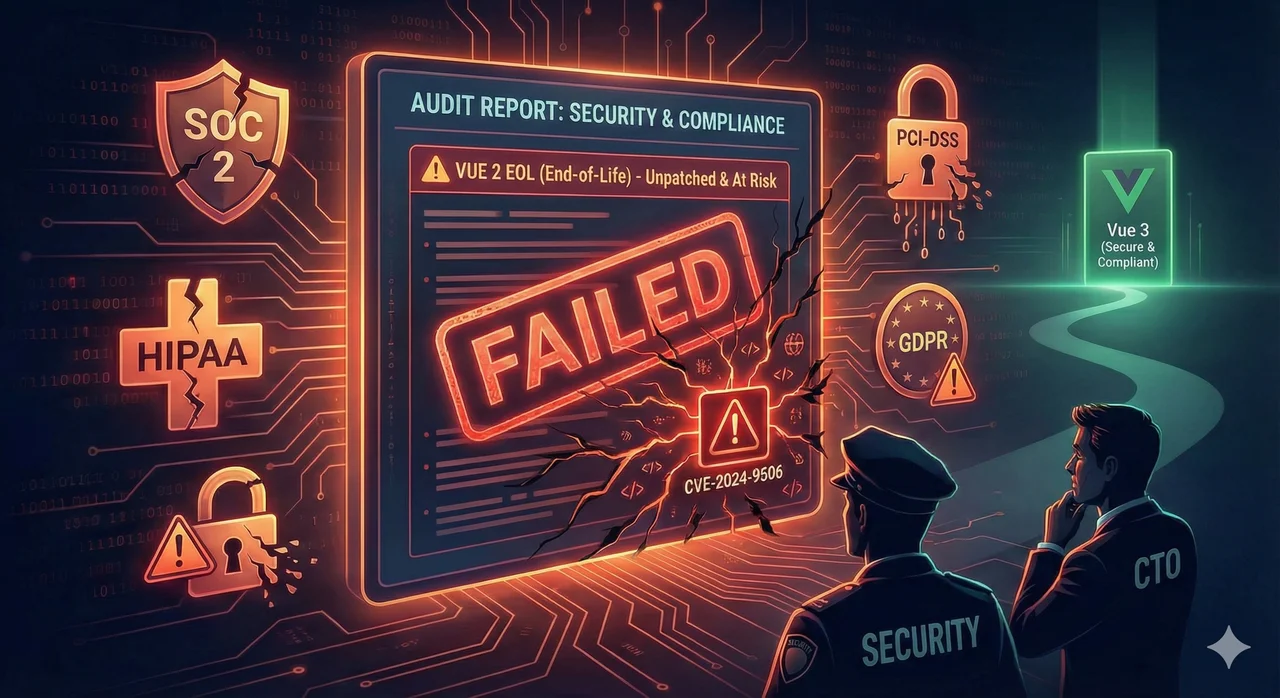
Let's start with a question that keeps security officers up at night: What happens when a CVE is discovered in your frontend framework and there's no one to patch it?
Vue 2 reached End-of-Life on December 31, 2023. That means the core team is no longer releasing security patches. No bug fixes. No vulnerability remediation. Your application is running on software that is, by definition, permanently unpatched.
For most companies, this isn't just a technical inconvenience. It's a compliance violation waiting to happen. If you're a non-technical leader trying to understand the business implications, our CEO's guide to Vue 2 EOL breaks it down in plain English.
What "End of Life" Actually Means for Security
When software reaches EOL, it doesn't suddenly become insecure. But it does become increasingly vulnerable over time. Here's why:
1. New Vulnerabilities Are Still Being Discovered
Security researchers don't stop finding bugs just because a project is EOL. New CVEs (Common Vulnerabilities and Exposures) are being discovered for Vue 2 right now. The difference is that there's no official team to fix them.
2. Known Vulnerabilities Remain Unpatched
CVE-2024-9506 is a ReDoS (Regular Expression Denial of Service) vulnerability affecting Vue 2. It was discovered after EOL. Unless you're paying for extended support, this vulnerability exists in your production application right now.
3. The Attack Surface Grows Over Time
Every day, security researchers are probing EOL software for weaknesses. Attackers know that companies are slow to migrate. Your Vue 2 application becomes a more attractive target as more vulnerabilities are discovered and never patched.
The Security Team's Nightmare
Your security team runs a vulnerability scan. They find a critical CVE in Vue 2. They open a ticket: "Patch required." But there is no patch. There never will be. The only remediation is migration—a project that takes months. What do they write in the audit response?
The Compliance Reality: How Auditors View EOL Software
Compliance frameworks don't specifically say "don't use Vue 2." But they all require you to maintain secure, patched software. Running EOL software violates the spirit—and often the letter—of every major compliance framework.
How Major Frameworks View EOL Software
SOC 2 Type II
SOC 2 requires that you maintain "system components" that are "supported by vendor." Running EOL software directly contradicts the CC6.1 control (vulnerability management) and CC7.1 (change management).
Auditor question: "How do you remediate vulnerabilities in software that no longer receives security updates?"
HIPAA Security Rule
HIPAA's Security Rule requires "protection against reasonably anticipated threats" (§164.306). Using software with known, unpatched vulnerabilities fails this standard. If PHI is exposed due to a Vue 2 vulnerability, you have no defense.
Auditor question: "What is your remediation plan for CVE-2024-9506 in your patient portal frontend?"
PCI-DSS 4.0
PCI-DSS Requirement 6.3.3 explicitly states that you must "address vulnerabilities by installing applicable security patches." When no patches exist, you are technically non-compliant by definition.
Auditor question: "Show me your patch management process for components that no longer receive vendor support."
GDPR
Article 32 requires "appropriate technical measures" to ensure security. Running EOL software that handles EU citizen data is difficult to defend as "appropriate." A breach caused by a known Vue 2 vulnerability could result in fines up to 4% of annual global revenue.
Regulator question: "Why was personal data processed using software with known security vulnerabilities?"
Inside the Auditor's Mind: What They're Looking For
Auditors aren't Vue experts. They don't know the difference between Vue 2 and Vue 3. But they do know how to ask uncomfortable questions about your software inventory.
Questions That Will Come Up in Your Next Audit
"Provide your software inventory with support status for each component."
You'll need to list Vue 2 as "End of Life" or lie on your audit documentation.
"Describe your vulnerability management process for EOL components."
What's your answer when there's no vendor to provide patches?
"What is your timeline for migrating off unsupported software?"
"We're working on it" isn't a compliant answer. They want dates.
"Show me compensating controls for running EOL software."
WAF rules and network segmentation only go so far. They're band-aids, not solutions.
"Has your risk committee formally accepted the risk of running EOL software?"
If not, someone is going to have to sign off on it. Will your CTO put their signature on that document?
The worst time to discover your compliance gap is during the audit. The second worst time is after a breach.
The Liability Chain: Who's Responsible When Things Go Wrong?
Let's play out a scenario. A vulnerability in Vue 2 is exploited. Customer data is exposed. The lawyers start asking questions. Who bears responsibility?
The CTO / VP of Engineering
"Why was the application still running on EOL software?" Leadership knew the risks. They made the decision to delay migration. That decision is now discoverable in litigation.
The Security Team
"Why wasn't this flagged as a critical risk?" Security knew the software was EOL. If they didn't escalate it as a critical finding, that's a process failure.
The Board
"Were you informed of this risk?" If the board wasn't briefed on the EOL software risk, that's a governance failure. If they were briefed and didn't act, that's worse.
The Company
Ultimately, the organization pays the price: regulatory fines, legal fees, customer notification costs, reputation damage, and lost business. The average cost of a data breach in 2024 is $4.88 million.
The Legal Discovery Nightmare
In litigation, opposing counsel will subpoena your internal communications. Every Slack message, every Jira ticket, every email where someone mentioned "we should probably migrate off Vue 2" becomes evidence that you knew the risk and chose not to act.
Real Vulnerabilities, Real Risks: Vue 2 CVEs You Should Know About
This isn't theoretical. Here are actual vulnerabilities affecting Vue 2 and its ecosystem:
CVE-2024-9506
Medium SeverityType: ReDoS (Regular Expression Denial of Service)
Impact: Attackers can craft malicious input that causes the application to hang, resulting in denial of service.
Status: Unpatched in official Vue 2. Only remediated through paid extended support or migration.
Ecosystem Vulnerabilities
OngoingVue 2 doesn't exist in isolation. Your application depends on dozens of packages that are also reaching EOL or dropping Vue 2 support:
- • Vuetify 2: No longer receiving security updates
- • Vue Router 3: In maintenance mode only
- • Vuex 3: Deprecated in favor of Pinia
- • Third-party libraries: Many have already dropped Vue 2 support entirely
The compounding risk: Every day, more packages in your dependency tree stop receiving updates. Your vulnerability surface isn't static—it's growing.
"But We Pay for Extended Support"—Is That Enough?
Some companies have opted for paid extended support services like HeroDevs NES. This does address the immediate security patching concern. But it doesn't eliminate the compliance conversation.
What Auditors Will Still Ask
"What is your long-term remediation plan?" Paid support is a temporary measure. Auditors want to see a migration roadmap.
"Does this cover your entire dependency tree?" Extended support covers Vue core. What about Vuetify? What about every npm package in your node_modules?
"What happens when this vendor discontinues support?" You've outsourced your security, but you haven't eliminated the risk. You've just deferred it.
Paid support can buy you time. But it's not a permanent solution, and auditors know it. At best, it's a documented compensating control. At worst, it's an expensive way to delay the inevitable.
The Path Forward: Turning Compliance Risk into Compliance Strength
Here's the good news: migrating to Vue 3 doesn't just eliminate your compliance risk—it strengthens your overall security posture.
What Migration Gives You (For Compliance)
Vendor-supported software
Back on the official security update track
Clear patch management
Standard npm update process for security fixes
Modern security features
Better TypeScript support, improved XSS protections
Audit-ready documentation
"We use Vue 3, actively supported by the Vue team"
The Compliance Conversation After Migration
Auditor: "Describe your frontend framework and its support status."
You: "We use Vue 3, the current major version, actively maintained by the Vue core team. Security patches are applied through our standard CI/CD pipeline within 48 hours of release."
That's the answer you want to give.
Don't Wait for the Audit Finding
The best time to address your Vue 2 compliance risk was before EOL. The second best time is now. Get a comprehensive migration audit that documents your current risk and provides a clear, fixed-price path to compliance.
✓ Full vulnerability assessment ✓ Compliance gap analysis ✓ Fixed-price migration quote
Conclusion
Running Vue 2 in production isn't just a technical debt problem—it's a compliance liability. Every day you delay migration, you're accumulating risk that auditors, regulators, and lawyers will eventually ask about.
The question isn't whether your next compliance audit will mention Vue 2. It's whether you'll have a satisfactory answer when it does. "We're working on it" isn't a compliance strategy. A documented migration plan with concrete timelines is.
Don't let your Vue 2 application become the finding that derails your SOC 2 certification, triggers a HIPAA investigation, or becomes exhibit A in a breach lawsuit. The cost of migration is predictable. The cost of a compliance failure is not.