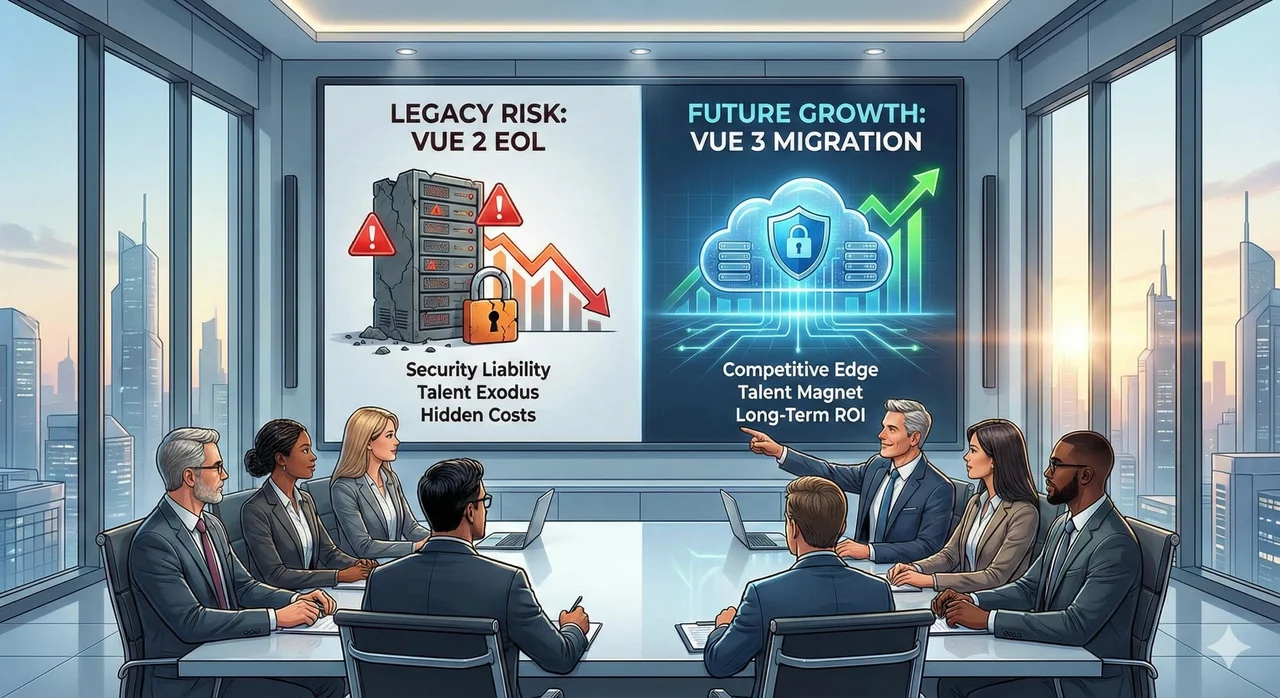
You don't need to understand the technical details. You need to understand the business implications. This guide cuts through the jargon and gives you exactly what you need: the risks, the costs, the options, and the questions to ask your technical team.
Reading time: 8 minutes. Potential impact: Hundreds of thousands of dollars and significant business risk.
First, the Basics: What Is Vue and What Does "End of Life" Mean?
What is Vue?
Vue (pronounced "view") is a software framework—think of it as the foundation your web application is built on. It's like the operating system for your app. Just as your laptop runs on Windows or macOS, your web application runs on Vue. It handles how users interact with your product, how data is displayed, and how the interface responds to clicks and inputs.
What Does "End of Life" Mean?
"End of Life" (EOL) means the creators of Vue 2 have officially stopped maintaining it. They no longer:
- Fix security vulnerabilities when they're discovered
- Release updates or improvements
- Provide official support or documentation
Vue 2 reached EOL on December 31, 2023. Your application is currently running on software that is no longer being maintained by anyone.
The Business Translation
Imagine your office building's security system. The company that made it has gone out of business. When someone discovers a way to break in, there's no one to fix it. You can hire a locksmith to patch individual locks, but the fundamental system is no longer supported. That's your Vue 2 application right now.
The Three Real Risks You Need to Understand
Your CTO may have mentioned technical concerns. Here's what those concerns actually mean for the business:
Security Liability
The Risk: Hackers actively look for vulnerabilities in EOL software because they know nobody is fixing them. When (not if) a security hole is discovered in Vue 2, your application becomes a target with no official patch available. For a deeper technical analysis, see our article on why your next compliance audit will fail.
The Business Impact:
- • Data breach costs average $4.88 million (IBM, 2024)
- • Regulatory fines (GDPR: up to 4% of global revenue)
- • Customer notification and credit monitoring costs
- • Reputation damage and customer churn
- • Potential litigation from affected customers
Key Question for Your CTO: "If a security vulnerability is discovered in Vue 2 tomorrow, what is our remediation plan?"
Talent Exodus
The Risk: Software developers care deeply about working with modern technology. It's how they stay employable. Asking talented developers to maintain a legacy system means asking them to let their skills become outdated.
The Business Impact:
- • Your best developers will leave for companies using modern stacks
- • Replacement cost: 50-200% of annual salary per developer
- • Hiring becomes harder—top candidates filter out legacy technology jobs
- • You'll pay a 20-30% salary premium for developers willing to work on old tech
- • Knowledge walks out the door with every departure
Key Question for Your CTO: "How many of our developers have expressed concerns about working with Vue 2? What's our turnover been in the engineering team?"
Competitive Disadvantage
The Risk: Modern software frameworks enable faster development, better performance, and features that legacy systems can't match. Your competitors on Vue 3 are shipping features faster with smaller teams.
The Business Impact:
- • Slower feature development (building on old foundations takes longer)
- • Performance limitations (Vue 3 is measurably faster)
- • Unable to adopt new tools and libraries (they only support Vue 3)
- • Technical debt compounds—every feature becomes harder to build
- • Your application feels "old" compared to competitors
Key Question for Your CTO: "How much slower is our feature development compared to what it could be on modern technology?"
Your Three Options (And What They Really Cost)
When your CTO comes to you with this problem, they'll likely present options. Here's how to evaluate them:
Option 1: Do Nothing
High RiskContinue running on Vue 2 without any changes. Hope nothing bad happens.
Upfront Cost:
$0
Ongoing Cost:
Accumulating risk and technical debt
This is not a strategy. This is hoping you get lucky. Every day increases your exposure.
Option 2: Pay for Extended Support
Band-AidThird-party companies offer paid security patches for Vue 2. This addresses the immediate security concern but nothing else.
Typical Cost:
$40,000+ per year
What It Solves:
Security patches only
You're paying rent on a declining asset. The migration is still inevitable—you're just delaying it while paying annual fees.
Option 3: Migrate to Vue 3
Permanent SolutionUpgrade your application to the current, supported version. This is the only option that solves all three risks permanently.
Typical Cost:
$50,000 - $100,000 (one-time)
What It Solves:
Security, talent, and competitive issues
One-time investment with positive ROI. Eliminates ongoing support costs and unlocks modern capabilities.
The Math: One Chart That Tells the Story
Here's a simple 3-year cost comparison that cuts through the complexity:
3-Year Total Cost of Ownership
| Scenario | Year 1 | Year 2 | Year 3 | Total |
|---|---|---|---|---|
| Paid Support | $40,000 | $40,000 | $40,000 | $120,000 |
| Migration | $70,000 | $0 | $0 | $70,000 |
3-Year Savings from Migration: $50,000+
Plus: Modern technology, better talent retention, and faster feature development
The Hidden Math
This comparison doesn't include the cost of losing developers ($50K-$100K per departure), the cost of a security breach ($4.88M average), or the opportunity cost of slower feature development. When you factor those in, migration isn't just cheaper—it's the only financially responsible option.
5 Questions to Ask Your CTO Before the Next Board Meeting
Arm yourself with these questions to have an informed conversation with your technical leadership:
"What is our current security remediation plan for Vue 2 vulnerabilities?"
Listen for: A concrete plan, not "we're monitoring the situation."
"What is the estimated cost and timeline for migration?"
Listen for: Specific numbers based on a real assessment, not guesses.
"Can we continue shipping features during migration, or does development freeze?"
Listen for: A strategy for parallel development. A complete freeze is usually avoidable.
"Have we gotten a fixed-price quote, or are we looking at hourly billing?"
Listen for: A fixed-price option. Hourly billing for migrations often spirals.
"What is the risk to the business if we delay this decision by 12 months?"
Listen for: Honest assessment of accumulating risk and cost.
The Bottom Line for Decision Makers
This is not a technical decision. It's a business decision.
The technology details are your CTO's domain. The risk tolerance, budget allocation, and strategic priorities are yours.
The migration will happen eventually. The only question is when.
Delaying doesn't avoid the cost—it increases it. Technical debt compounds. Talent leaves. Risk accumulates.
Fixed-price options exist. You don't have to write a blank check.
Specialist firms can audit your codebase and provide guaranteed fixed-price quotes. Budget certainty is achievable.
Get the Data You Need to Decide
Don't make a six-figure decision based on guesses. Get a comprehensive audit that gives you real numbers: the actual scope of work, a fixed-price quote, and a clear timeline. Share it with your board with confidence.
✓ Board-ready documentation ✓ Fixed-price guarantee ✓ Clear timeline and milestones
Conclusion
You don't need to become a Vue expert to make this decision. You need to understand that your application is running on unsupported software, that this creates real business risk, and that there are clear options with quantifiable costs.
The technical team can handle the implementation. Your role is to ensure the business isn't caught off-guard by a preventable problem. A security breach, a mass developer exodus, or a compliance failure shouldn't be how you learn about Vue 2 EOL.
This article gives you what you need to have an informed conversation with your CTO and make a strategic decision. The sooner you start that conversation, the more options you'll have.