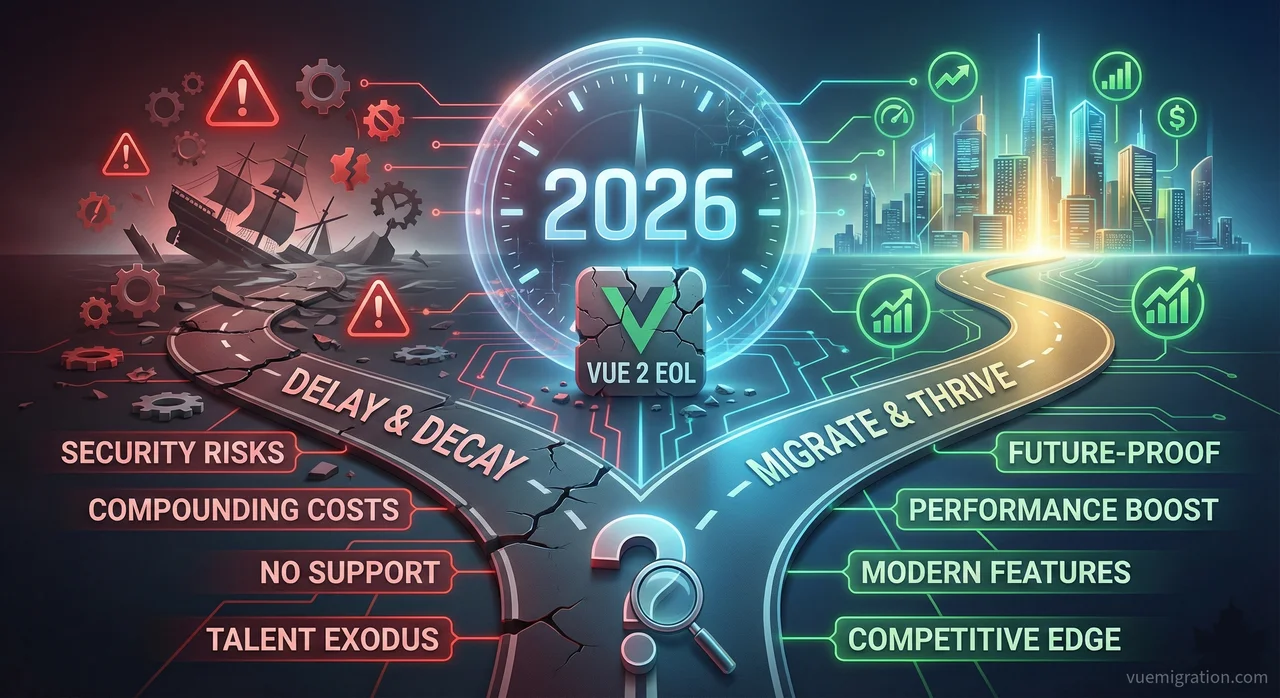
Current Status: Over 2 Years Past EOL
EOL Date
Dec 31, 2023
Time Since EOL
2+ Years
Official Security Patches
None
What "End of Life" Actually Means
End of life doesn't mean Vue 2 stops working. Your application will continue to run. But here's what it does mean:
No Security Patches
When vulnerabilities are discovered, the Vue team will not fix them. You're on your own.
No Bug Fixes
Even critical bugs won't be addressed. What exists today is what you'll have forever.
No New Features
The framework is frozen. While Vue 3 evolves, Vue 2 stays exactly where it was.
Declining Ecosystem
Libraries, plugins, and tools are dropping Vue 2 support. Dependencies become abandoned.
Consequence #1: Security Vulnerabilities
Risk level: Critical
Security vulnerabilities in Vue 2 won't be patched by the Vue team. Any new CVEs discovered—in Vue core or the broader ecosystem—leave your application exposed.
Known Vulnerabilities
- CVE-2024-6783: XSS vulnerability in Vue 2.x SSR
- Ecosystem: Vuetify 2.x, BootstrapVue, Vue Router 3.x all have known issues
- Transitive: Old versions of lodash, webpack-dev-server, node-sass with vulnerabilities
Every month that passes increases the likelihood of a serious vulnerability being discovered—one that attackers know won't be patched.
See complete list of Vue 2 security vulnerabilities →Consequence #2: Compliance Failures
Risk level: High
Running EOL software violates most security compliance frameworks. If your organization is subject to SOC 2, HIPAA, PCI-DSS, or GDPR, your Vue 2 application creates audit risk.
Framework Requirements
SOC 2 Type II
Requires documented procedures for managing unsupported software. Auditors will flag EOL frameworks.
PCI-DSS
Requirement 6.2: All system components must be protected from known vulnerabilities. EOL = non-compliant.
HIPAA
§164.308(a)(5)(ii)(B): Security updates must be applied. No updates = no compliance.
GDPR
Article 32: "Appropriate technical measures" for security. Running unpatched software fails this test.
Auditors are increasingly aware of JavaScript framework EOL dates. Expect questions about Vue 2 in your next audit.
Consequence #3: Developer Exodus
Risk level: High
Developers don't want to work on legacy frameworks. Working with Vue 2 in 2026 means:
Career stagnation
Vue 2 experience is becoming less valuable. Developers know this.
Missing modern tooling
No Composition API, no Vite, no first-class TypeScript.
Frustrating DX
Working around known bugs that will never be fixed.
Resume concerns
"Vue 2" on a resume in 2026 raises questions.
The hiring problem: New developers don't want to join Vue 2 projects. Your existing developers are looking at Vue 3 jobs elsewhere.
Consequence #4: Accelerating Technical Debt
Risk level: Medium → Critical
The longer you wait, the harder migration becomes. This isn't linear—it's exponential.
Why Migration Gets Harder Over Time
- • More code: Every feature you build in Vue 2 is code you'll need to migrate later.
- • Deeper patterns: Vue 2 patterns (mixins, filters) become more entrenched.
- • Knowledge loss: Developers who understand the codebase leave. Institutional knowledge evaporates.
- • Dependency rot: More packages become abandoned. Alternatives become harder to find.
- • Tool chain decay: Build tools, testing frameworks, and development environments become increasingly incompatible.
Migration Cost Over Time
Consequence #5: Falling Behind Competitors
Risk level: Medium
While you maintain Vue 2, competitors on Vue 3 are shipping faster with better tooling.
What Vue 3 Teams Have
- ✓ Vite: 10-100x faster builds. Instant HMR. Developers shipping features faster.
- ✓ Composition API: Better code organization, easier testing, more reusable logic.
- ✓ TypeScript: First-class support means fewer bugs, better refactoring, faster onboarding.
- ✓ Smaller bundles: Vue 3 is tree-shakeable. Faster load times for users.
- ✓ Modern ecosystem: Pinia, VueUse, Nuxt 3—all the best tools are Vue 3 only.
Your Options in 2026
You have three paths forward. Each has trade-offs:
Migrate to Vue 3
The permanent solution. One-time investment that eliminates all EOL risks and positions you for the future.
Pros
- • Eliminates security/compliance risk
- • Improves developer satisfaction
- • Modern tooling and performance
- • One-time cost (no ongoing fees)
Cons
- • Upfront time and cost
- • Temporary feature freeze during migration
- • Team needs to learn new patterns
Pay for Extended Support
Services like HeroDevs NES provide security patches for EOL frameworks. Buys time but doesn't solve the underlying problem.
Pros
- • Immediate security coverage
- • No code changes required
- • Satisfies some compliance requirements
Cons
- • Ongoing subscription cost ($50K-200K+/year)
- • Doesn't fix talent or tooling issues
- • Migration still inevitable
- • Technical debt continues growing
Do Nothing
Continue running Vue 2 without support. Accept the risks.
Pros
- • No immediate cost or effort
- • No disruption to current work
Cons
- • Security vulnerabilities unpatched
- • Compliance audit failures
- • Developer attrition
- • Competitive disadvantage
- • Migration cost increases yearly
- • Eventually forced to migrate anyway
The 2026 Reality Check
Let's be direct: every Vue 2 application will eventually migrate or be replaced. The only questions are when and at what cost.
The Math Is Simple
- • Migrating today costs X.
- • Migrating next year costs X + 25-40%.
- • Extended support costs $50K-200K/year AND you still pay X+ later.
- • "Do nothing" costs your security, compliance, talent, and competitive position—AND you still pay X++ eventually.
The best time to migrate was 2024. The second best time is now.
Ready to Move Forward?
Our Migration Readiness Audit gives you a clear picture of what your migration will take—timeline, cost, and potential blockers—with a fixed-price quote.
✓ Fixed-price quote ✓ Realistic timeline ✓ No obligation
Conclusion
Vue 2 end of life isn't a future event—it happened over two years ago. Every day your application runs on Vue 2, you're accumulating risk: security vulnerabilities, compliance exposure, developer attrition, and growing migration costs.
The consequences aren't theoretical. They're happening now to teams that chose to wait.
Whether you migrate yourself, hire specialists, or accept the risks—make it a conscious decision. Ignoring the problem doesn't make it go away. It just makes it more expensive to solve later.