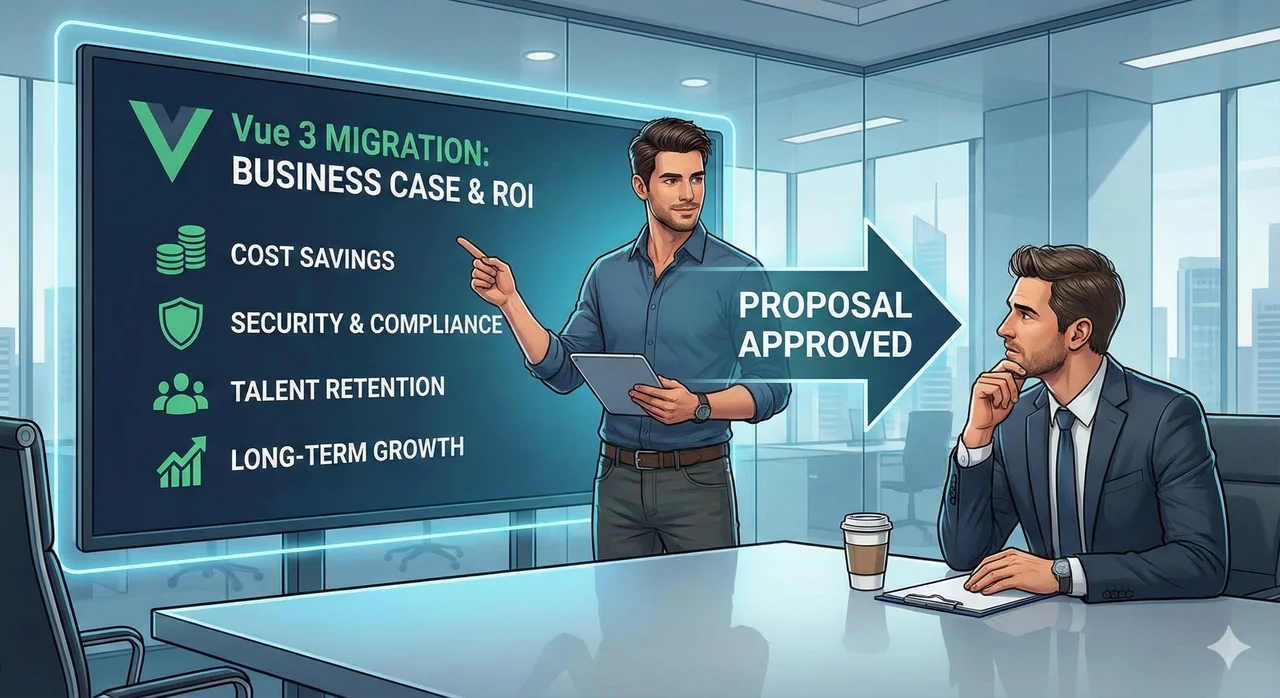
Technical debt is invisible to non-technical stakeholders. Saying "Vue 2 is end-of-life" doesn't resonate the way "we have a security vulnerability" or "we'll lose our SOC 2 certification" does.
This guide helps you translate technical necessity into business language. You'll learn what managers actually care about, how to build an airtight business case, and how to handle the objections that always come up.
Understand What Your Manager Actually Cares About
Your manager isn't anti-migration. They're balancing competing priorities with limited resources. Understanding their concerns is step one.
What Managers Are Thinking
"How much will this cost?"
They need a number. Vague estimates like "a few months" won't work.
"What features will we NOT ship while doing this?"
Migration competes with roadmap items. They need to justify the trade-off.
"What happens if we don't do this?"
If there's no consequence to waiting, why prioritize it now?
"What's the risk if we DO this?"
Could it break the app? Go over budget? Take longer than estimated?
"How do I explain this to MY manager?"
They need talking points for the exec team.
Key insight: Frame migration as risk mitigation and cost avoidance, not as a technical upgrade. "Preventing a security breach" beats "modernizing our stack."
Build an Airtight Business Case
A good business case has four components: cost of action, cost of inaction, risk analysis, and proposed approach.
A. Cost of Inaction (What Happens If We Don't Migrate)
This is your most powerful argument. Make the risks concrete and quantifiable.
- Security: "Vue 2 has known CVEs that won't be patched. A breach could cost us $X in incident response + reputation damage + potential fines."
- Compliance: "Running EOL software violates SOC 2/PCI-DSS/HIPAA. Our next audit is [date]. Remediation costs $X."
- Talent: "Replacing a senior developer costs $50-100K (recruiting + ramp-up). We've already lost X people who cited legacy tech."
- Escalating cost: "Migration cost increases 25-40% per year. Waiting until next year costs an additional $X."
B. Cost of Action (What Migration Actually Costs)
Be specific. Vague estimates undermine credibility.
- • Timeline: "Based on our codebase size, estimated 8-12 weeks with 2 dedicated developers."
- • Team cost: "At fully loaded rate, approximately $X-Y."
- • Feature impact: "Feature velocity reduced by X% during migration, with full velocity restored after."
- • Alternative: "Outsourcing to specialists costs $X but preserves internal feature velocity."
C. The ROI Calculation
Show the math. Managers love concrete numbers.
Sample ROI Frame
D. Risk Mitigation (How We'll Reduce Risk)
Address their fear of project failure proactively.
- ✓ "We'll use Vue's official migration build (@vue/compat) for incremental migration."
- ✓ "We'll migrate component-by-component, deploying continuously—not a big-bang rewrite."
- ✓ "We'll add E2E tests for critical flows before migration to catch regressions."
- ✓ "We can rollback to Vue 2 at any point during the migration if needed."
- ✓ "We'll do a readiness audit first to identify blockers before committing to timeline."
Handle the Inevitable Objections
Prepare responses for these common pushbacks:
"Can't we just wait? Vue 2 still works."
Your response: "It works today, but we're accumulating risk. Vue 2 has been end-of-life since December 2023—over two years now. We have unpatched security vulnerabilities. Our next compliance audit will flag this. And the migration gets 25-40% more expensive every year we wait. Waiting isn't free—it's just a deferred cost with added risk."
Supporting data: Vue 2 EOL consequences →"We have more important features to build."
Your response: "I understand the roadmap pressure. But consider: every feature we build on Vue 2 is code we'll have to migrate later. Building on a deprecated foundation increases our total migration cost. And if we have a security incident or fail a compliance audit, those features won't matter. This is infrastructure that enables everything else."
"Can't we just pay for extended support?"
Your response: "Extended support (like HeroDevs NES) costs $50-200K per year and doesn't fix the underlying problem—we still need to migrate eventually. Over 3 years, we'd spend $150-600K AND still pay for migration. It's paying for a hotel room while also paying a mortgage. Migration is the permanent solution."
Supporting data: True cost of extended support →"What if it takes longer than estimated?"
Your response: "Valid concern. That's why I'm proposing we start with a migration readiness audit—a 1-2 week assessment that identifies blockers, dependencies, and gives us a realistic timeline before we commit. We can also get a fixed-price quote from migration specialists if we want cost certainty."
"Our developers don't know Vue 3."
Your response: "Vue 3 is intentionally similar to Vue 2—the Options API still works exactly the same. The learning curve is minimal. More importantly, our developers WANT to learn Vue 3. It's better for their careers, and working on modern tech improves retention. Keeping them on Vue 2 is actually a retention risk."
Supporting data: Developer retention risk →"We tried before and it failed/stalled."
Your response: "Let's learn from that. What blocked us? If it was part-time effort, I'm proposing dedicated time. If it was Vuetify complexity, let's address that first. If it was unclear scope, let's do a proper audit. Migration fails when it's treated as a side project—this proposal treats it as a first-class project with proper resourcing."
Present Your Proposal Effectively
Structure Your Pitch (5 Minutes Max)
- 1 The problem (30 sec): "Our frontend runs on Vue 2, which has been end-of-life for over two years. We have unpatched security vulnerabilities."
- 2 The risk (1 min): "This exposes us to [security incident / compliance failure / developer attrition]. The cost of inaction is $X per year."
- 3 The solution (1 min): "I'm proposing a Vue 3 migration. Estimated [X weeks] with [Y developers]. One-time investment of $Z."
- 4 The ROI (1 min): "3-year net benefit of $X through [avoided costs + productivity gains]."
- 5 The ask (30 sec): "I'm requesting approval to [start with an audit / dedicate 2 developers for Q2 / get an external quote]."
Do
- ✓ Lead with business impact, not tech details
- ✓ Have specific numbers ready
- ✓ Acknowledge the trade-offs honestly
- ✓ Propose a small first step (audit)
- ✓ Bring supporting documentation
Don't
- ✗ Start with "Vue 2 is old"
- ✗ Focus on developer happiness alone
- ✗ Give vague estimates ("a few months")
- ✗ Dismiss concerns as uninformed
- ✗ Ask for everything at once
Start Small: The "Foot in the Door" Strategy
If full migration approval is a hard sell, propose a smaller first step that reduces perceived risk:
Option A: Migration Readiness Audit
"Before committing to migration, let's spend 1-2 weeks assessing our codebase. We'll identify blockers, estimate effort, and decide with full information."
Low risk, provides concrete data for the real ask.
Option B: Proof of Concept
"Let's migrate one isolated module to Vue 3. We'll learn what's involved and can extrapolate timeline from there."
Demonstrates feasibility, builds team confidence.
Option C: External Quote
"Let's get a fixed-price quote from migration specialists. We'll have a real number to evaluate, not just estimates."
Shifts uncertainty to vendor, provides cost certainty.
When to Make Your Case
Timing matters. Look for these windows of opportunity:
Good Timing
- • Right before annual/quarterly planning
- • After a security incident (anywhere)
- • Before a compliance audit
- • When a key developer leaves
- • After a competitor ships faster
- • When hiring is difficult
Bad Timing
- • During a production crisis
- • Week before a major launch
- • Right after budget cuts
- • When team is already overloaded
- • During organizational restructuring
Need Ammunition for Your Proposal?
We can provide a detailed Migration Readiness Assessment with specific findings, timeline estimates, and a fixed-price quote—exactly what you need to get executive buy-in.
✓ Third-party validation ✓ Concrete numbers ✓ Executive-ready format
Conclusion
Getting migration approved isn't about proving Vue 2 is outdated—your manager probably already knows that. It's about making the business case so clear that not migrating becomes the risky choice.
Lead with risk and cost. Have specific numbers. Address objections before they're raised. Propose a small first step to reduce perceived risk.
And remember: your manager needs to sell this to their manager. Give them the talking points they need. Make it easy for them to say yes.
Resources for Your Proposal
Vue 2 to Vue 3 Migration Cost Guide
Detailed cost breakdown to support your business case.
Realistic Migration Timelines
Timeline estimates by project size for your proposal.
The CEO's Guide to Vue 2 EOL
Executive-friendly summary to share with leadership.
Vue 2 Security Vulnerabilities
Specific CVEs to cite in your security risk argument.