
December 31, 2023, has come and gone. Vue 2 is officially End-of-Life (EOL).
If you are a CTO or Tech Lead managing a complex, revenue-generating Vue 2 application, you are likely feeling the pressure. You know you can't run unpatched software forever due to security risks and compliance mandates like GDPR.
The market has responded with a tempting solution: Paid Extended Support (NES). Services now exist that promise to keep patching Vue 2 for a monthly or annual fee.
It sounds like the perfect "easy button." You pay a fee, the anxiety goes away, and you don't have to disrupt your roadmap with a massive migration project.
But here is the hard truth that those services won't tell you: Extended support is not a solution. It is an expensive sedative.
By choosing paid support over migration, you aren't fixing the problem. You are entering a trap that will cost your business significantly more time, money, and talent in the long run. Here is why.
Trap #1: The Financial Illusion (Renting vs. Owning)
Paying for Extended Long-Term Support (LTS) feels financially prudent in the short term because it avoids the capital expense of a migration project.
However, you need to look at OpEx (Operational Expenditure) versus CapEx (Capital Expenditure).
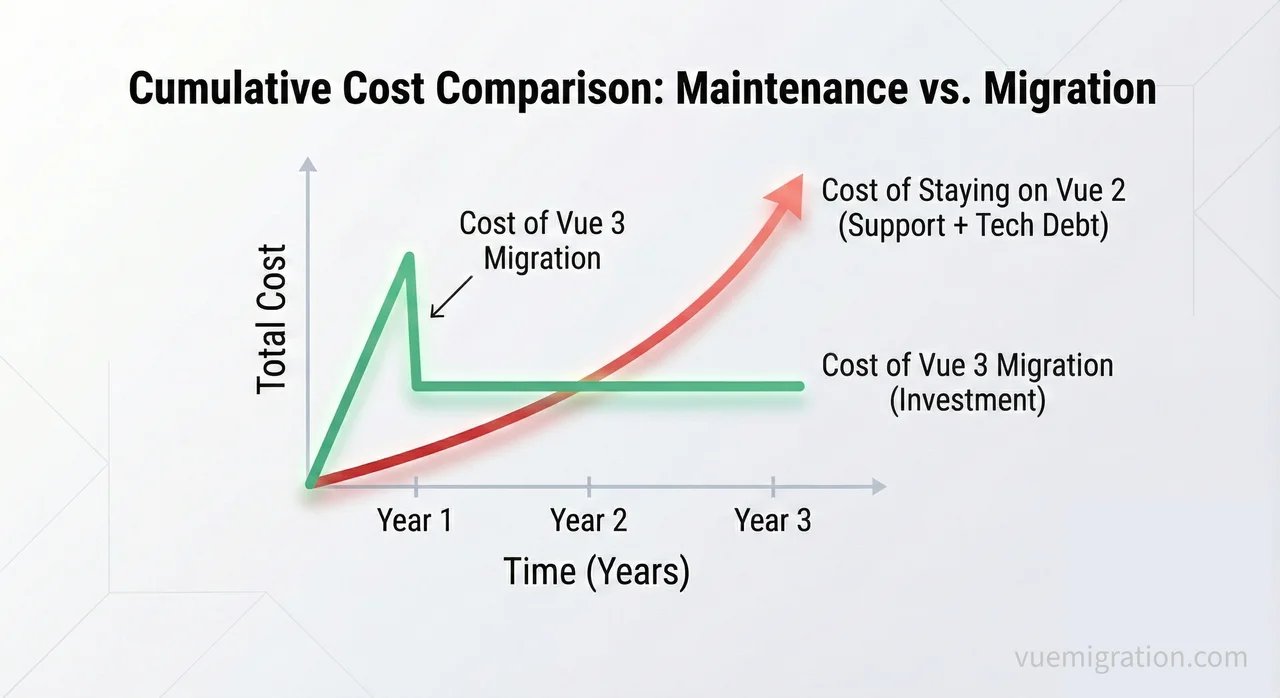
Extended support is pure OpEx. It is rent paid on a decaying asset. Every dollar you spend on support is a dollar spent just to keep the lights on today. It adds zero future value to your product. In two years, after spending tens of thousands of dollars on support fees, you still have a Vue 2 application. You are exactly where you started, just poorer. We break down the true cost of never-ending Vue 2 support in detail.
A migration is an investment. Yes, it has an upfront cost. But once complete, that cost goes to zero, and you own a modern, performant asset that is cheaper to maintain.
Stop paying rent on a condemned building. Invest in a new one.
Trap #2: The Explosive Growth of Technical Debt
Vue 2 core might get security patches through paid support, but your application is not just Vue core. It's an ecosystem.
Your application relies on routers, state management (Vuex), UI component libraries (like Vuetify 2 or BootstrapVue), testing utilities, and build tools (Webpack).
The rest of the world has moved on.
Third-party libraries are dropping Vue 2 support rapidly.
Critical security vulnerabilities in dependencies of Vue 2 packages may never get patched.
Modern build tools like Vite, which offer 10x faster development experiences, are optimized for Vue 3.
By staying on Vue 2, you are freezing your technology stack in 2023. As the web evolves around you, every new feature you want to build becomes harder, hackier, and more expensive to implement because your tools are fighting you.
Trap #3: The Talent Crisis (The Silent Killer)
This is the risk that keeps CTOs up at night.
Developers want to work with modern technologies. They want to build resume value. They want to use the Composition API, Pinia, and TypeScript integration that Vue 3 offers.
Asking a talented JavaScript developer in 2025 to work full-time on a legacy Vue 2 codebase is a recipe for:
Low Morale
They know they are falling behind industry standards.
High Turnover
Your best developers will leave for companies using modern stacks.
Hiring Nightmares
Try posting a job opening for a "Vue 2 Specialist." The talent pool is shrinking, expensive, and often lacks the ambition you need to grow your product.
A Vue 3 migration isn't just a technical upgrade; it's a signal to your team (and future hires) that you invest in your engineering culture.
Trap #4: You Have to Migrate Anyway
This is the ultimate reality of the trap.
Extended support doesn't last forever. Maybe you buy yourself 18 months or 2 years. But eventually, the support contracts will end, or the technical debt will become insurmountable.
You will eventually have to migrate to Vue 3.
If you choose extended support now:
- • Cost of 2 Years of Support + Cost of a Migration in 2026 (which will be harder due to accumulated debt)
If you choose to migrate now:
- • One-time cost of Migration today.
Paying for support is just paying a premium to delay the inevitable, while making the eventual migration even harder.
The Escape Route: A Predictable, Fixed-Price Migration
The fear of migration is understandable. We've all seen rewrite projects that go wildly over budget and take years.
But a Vue 2 to Vue 3 migration doesn't have to be a black hole of time and materials billing. It is a solvable, quantifiable engineering problem.
The first step isn't committing to a massive project. The first step is understanding the scope.
Don't guess at the cost. Get the data.
We offer a fixed-price Migration Readiness Audit. We scan your entire codebase to identify every deprecated pattern, every risky dependency, and every potential blocker. We don't just give you a report; we give you a firm, fixed-price quote and timeline to move your application to Vue 3.
Stop paying to stand still. See what it actually costs to move forward.
Stop Paying to Stand Still
Don't let extended support become a permanent cost. Get a comprehensive audit that shows you exactly what migration will cost—and why it's the smarter investment than paying for support indefinitely.
✓ Fixed-price guarantee ✓ No commitment required ✓ Delivered in 7 business days
Conclusion
Extended support for Vue 2 is not a solution—it's an expensive way to delay the inevitable. Every dollar you spend on support is a dollar that doesn't add value to your product. Every month you delay is technical debt that makes the eventual migration harder and more expensive.
The choice is clear: pay indefinitely to maintain a dead platform, or invest once in a permanent migration that pays for itself. Don't fall into the trap. Get the data, make the smart decision, and move forward.