Retention on Vue 2 and hiring for Vue 3 are two sides of one market. The signal you want: comfort with incremental delivery, testing under time pressure, and clear communication with product— not someone who has only done greenfield Composition API in bootcamp side projects.
1. The job post: be explicit about the migration
State that production is on Vue 2, target is Vue 3, and the role includes untangling UI libraries, router, and i18n—not only new features on fresh Vue 3 greenfield.
Mention @vue/compat or strangler patterns if you use them; it filters tourists.
2. Interviews: one real SFC, one state question
Ask candidates to talk through upgrading a small Vue 2 SFC: props, events, v-model in Vue 3, and when they would add a test. Follow with how they would migrate a store slice to Pinia.
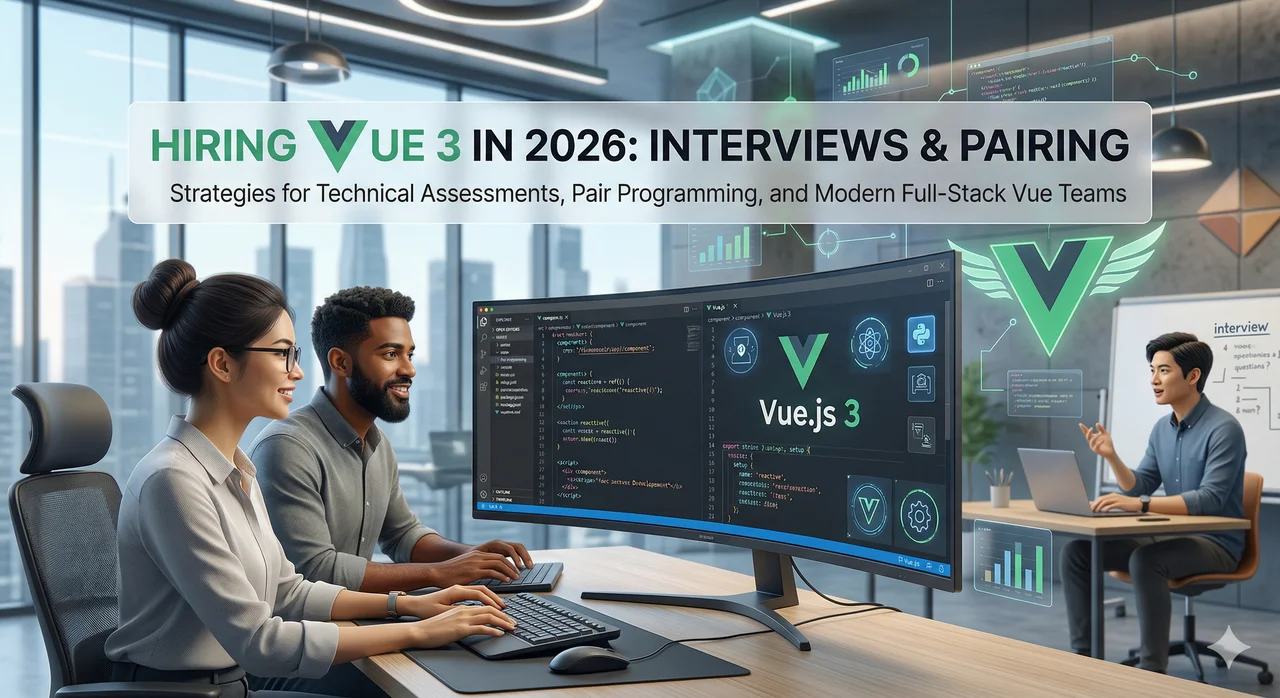
3. Pairing day (paid)
Half a day on a branch against your actual repo (with secrets stripped) outperforms six Leetcode mediums. You see who asks for context, who writes small commits, and who reaches for the debugger versus guessing.
4. A job post template that filters out tourists
The structure that consistently lifts our quality-to-volume ratio looks like this. Steal it.
Senior Vue Engineer (Vue 2 → Vue 3 migration)

What you will actually do, weeks 1–12:
- Convert ~3–6 Vue 2 SFCs/week to Vue 3 + script setup
- Replace Vuex modules with Pinia stores, slice by slice
- Fix breaking changes in our Element UI / Vuetify 2 surfaces
- Pair with a tester to keep Cypress green during the cutover

You will NOT be:
- Picking a new framework
- Writing greenfield Vue 3 from scratch for 6 months
- Rewriting the design system

Must have:
- Shipped Vue in production for 2+ years
- Touched at least one Vue 2 → Vue 3 migration (any size)
- Comfortable with @vue/compat OR a strangler-fig approach
- Reads code before changing it
The "you will NOT" block is the one most teams skip. It is the single highest-signal section. Candidates self-select out, and the ones who stay tend to be honest about what migration work is.
5. Interview signals that actually correlate with shipping
After a few hundred Vue interviews, these are the signals we trust. The ones we no longer trust are framework trivia, framework version popularity, and "personality fit" panel rounds.
High-signal questions
- "Walk me through this Vue 2 SFC. What would change in Vue 3, and what would you ship first?" — Tests prioritization.
- "This component has no test. You have 30 minutes. What do you write?" — Tests pragmatism.
- "You have a Vuex module with three actions and a getter. Migrate it to Pinia." — Tests store migration familiarity.
- "What would you do in week one on a 200-component Vue 2 codebase?" — Tests how they enter unfamiliar systems.
- "Tell me about a migration that went badly. What did you learn?" — Tests honesty.
Low-signal questions to drop
- "What is the difference between
refandreactive?" — Trivia, looked up in 5 seconds. - "Implement a debounce." — Generic, not Vue.
- "Whiteboard a virtual DOM diff." — Almost nobody touches this in real work.
- "What's new in Vue 3.4?" — Memorization.
6. The pairing day, in detail
A paid 4-hour pairing session against a sanitized branch of your real repo is the single best predictor of fit we have found. Structure it like this:
- Hour 1 — context. The interviewer drives. Walk them through the repo, the migration plan, and the failing test you want fixed. Watch what questions they ask. Good candidates ask about constraints and definitions of done; weak candidates start typing.
- Hour 2 — small change. Convert one SFC from Options API to
<script setup>. Watch how they navigate, search, and read. Do they run the tests? Do they read adjacent files? - Hour 3 — bigger change. Migrate a small Vuex module to Pinia, or fix a real production bug from your tracker. This is where senior signal shows up.
- Hour 4 — debrief. Ask the candidate to write a short Slack-style update on what they did, what they learned, and what they'd do next. Communication under fatigue is a real signal.
Pay market rate for the day. Candidates who decline a paid pairing are often the same candidates who would have ghosted in week three.
7. Levels and ratios on a migration team
| Level | What they own | Healthy ratio |
|---|---|---|
| Staff / Tech lead | ADRs, dependency contracts, escalation | 1 per 6–8 engineers |
| Senior | Hardest surfaces (router, store, UI kit) | ~50% of team |
| Mid | SFC conversions, test coverage, PR review | ~35% |
| Junior | Mechanical conversions, lint cleanup, doc updates | ~15% |
Teams heavy on juniors tend to under-budget the painful surfaces. Teams that are 100% senior overpay and under-deliver on the mechanical work. Mix matters. See our timeline guide for how staffing choices interact with calendar.
8. Anti-patterns we see in Vue hiring
- Hiring "a Vue 3 person" to fix the migration. The migration needs people who are happy operating in Vue 2 today. Greenfield-only candidates often hate the work.
- Six-round panels. Senior Vue engineers in 2026 have options. Long loops kill offer acceptance rates.
- Take-homes longer than 3 hours. Pay for pairing instead—signal is higher per hour invested.
- Refusing remote. The pool of senior Vue talent is global. Restricting to one timezone for an internal admin tool is self-inflicted.
- Underleveling. Hiring at "mid" and expecting senior output is the fastest way to lose the people already considering leaving.
9. Onboarding that doesn't burn the new hire
Days 1–10 should not be "ramp on Confluence." A migration onboarding that works:
- Day 1: laptop, repo, dev environment, one merged PR (a typo fix is fine).
- Days 2–3: shadow a senior on a real SFC migration; the new hire writes the test.
- Days 4–7: own one small SFC migration end-to-end with a buddy reviewer.
- Day 10: present the migration playbook back in their own words at standup. If they can teach it, they have it.
- Week 4: own a slice of the migration checklist.
FAQ
Should we hire contractors or full-time for the migration?
Both. A small contracting cell accelerates the painful first quarter; full-time hires sustain the work and own the post-migration platform. Contractors-only tends to leave knowledge debt.
React engineers — viable?
Senior frontend engineers can pick up Vue 3 quickly. Vue 2 quirks (reactivity caveats, options API patterns) are harder to internalize. We'd cross-train for greenfield, not for legacy migration surfaces.
How do we test for migration-specific judgment?
Show them a real ADR or migration plan and ask what they would change. Listen for trade-off vocabulary, not opinions.
When do we know the team is ready to move from "migration" to "platform"?
When the last Vue 2 deployable is gone, error rates are flat, and you can ship a feature without first checking whether you're on the migration branch.
You need a bench, not a single hero
We augment teams and help define roles when the hiring market is tight.
Plan staffing with usConclusion
Write posts that repel the wrong fit, interview for migration shape, and validate with paid pairing. That combination cuts mis-hires and shortens the path to a sustainable Vue 3 team.